Three drives in the room
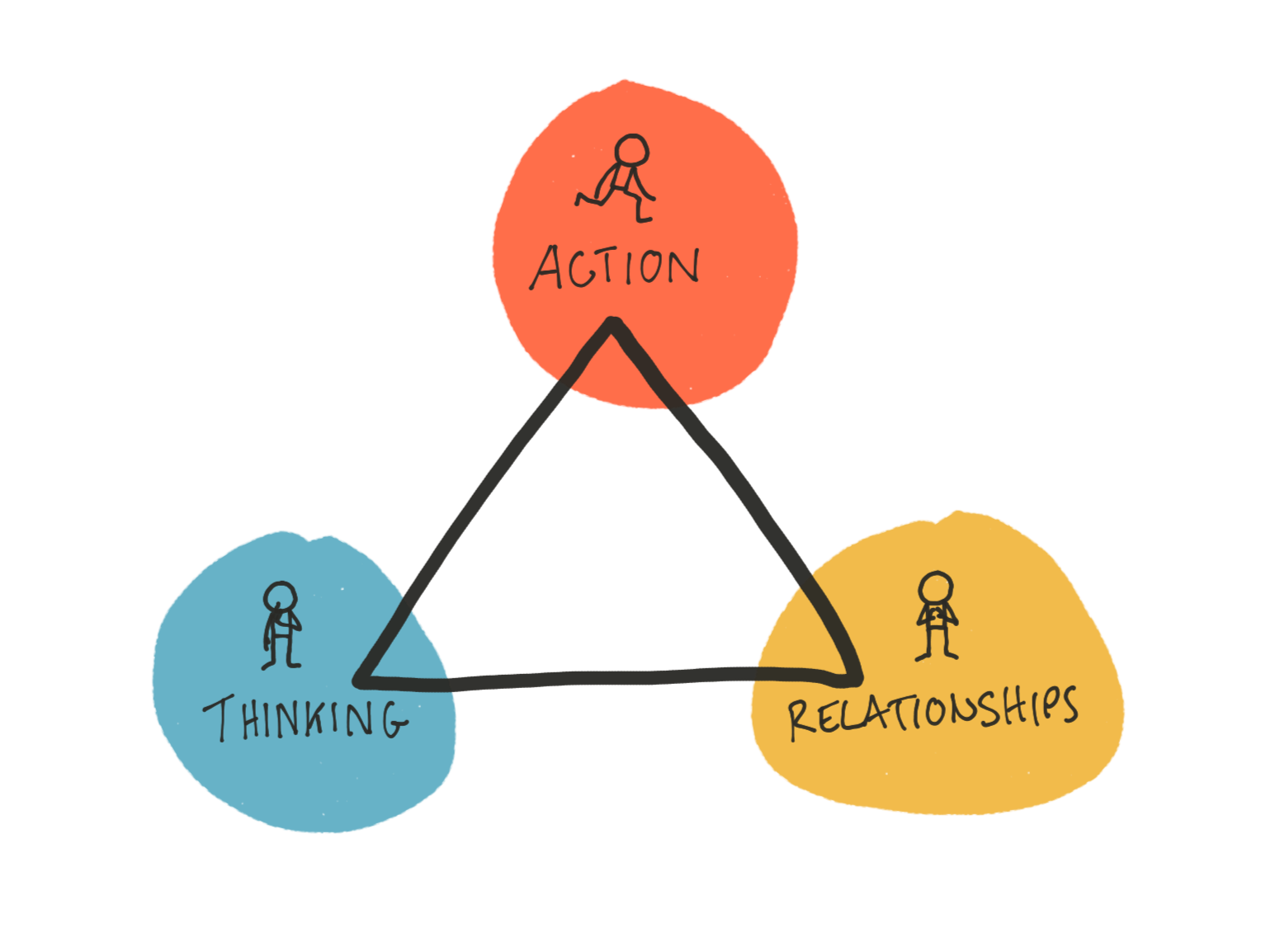
A triangle with a label in each corner - action (in the top corner), thinking (in the left bottom corner) and relationships (in the right bottom corner). A stick person accompanies each label in an appropriate poise.
I’ve been reading about a simple way to understand how people show up at work.
It’s not a new model. You’ll see versions of it everywhere. But it’s one of those ideas that’s immediately useful.
It says we all lean towards three core drives:
action
thinking
relationships
Most of us use all three. But one tends to dominate, especially under pressure.
Once you see this, you can’t unsee it!
You can hear it in the first five minutes
In almost any workshop, the pattern shows up fast.
Someone says:
“let’s just get on with it”
“what does the data actually say?”
“how will this land with people?”
Three different instincts. Three different priorities.
You can label them if you like:
tough battlers (action)
logical thinkers (thinking)
friendly helpers (relationships)
The labels don’t matter as much as the pattern.
Why this matters
A lot of our work sits in the tension between these three.
For example, we might bring together:
clinicians who want to act
analysts who want certainty
community teams who care about relationships
And then we ask them to agree on something. That’s where it gets interesting.
Because most disagreements aren’t really disagreements.
They’re collisions between drives.
action vs thinking → “you’re slowing us down”
thinking vs relationships → “this isn’t grounded in reality”
relationships vs action → “this feels rushed and insensitive”
Same problem. Different lenses.
The trap facilitators might fall into
It’s easy to think your role is to “balance the room”.
To give everyone equal airtime.
To make it all feel fair.
But that can flatten things.
A better move is to work with the energy that’s there.
if the room is full of action → help them pause just enough to think
if the room is full of thinking → help them move before it stalls
if the room is full of relationships → help them land decisions
A facilitator shouldn't be entirely neutral. You’re not there to sit back. You’re shaping the conditions for progress.
Spotting your own default
This is the uncomfortable bit. Most of us have a home base.
Under pressure, we go there.
I tend to over-explain → thinking
I push for momentum → action
I soften things to keep the peace → relationships
None of these are wrong.
But they shape how we show up.
And they shape what we miss.
A small shift that changes everything
Try asking:
What does each person care about most right now? (me included)
Then adjust slightly.
with action → be brief, focus on outcomes
with thinking → bring structure, show your working
with relationships → acknowledge impact, bring others in
You don’t need to perform a different personality.
You just need to meet everyone where they are.
Bringing unlikely people together
This is the real work.
Not the artefacts. Not the frameworks.
It’s helping people see each other’s intent.
The clinician pushing for speed isn’t careless. The analyst asking for more data isn’t obstructive. The community lead focusing on relationships isn’t avoiding decisions.
They’re all trying to do a good job.
Just through different lenses
A final thought
These models are shortcuts.
But in messy, cross-system work, good shortcuts are helpful.
If you can spot the dominant drive in the room, you can shift things.
And sometimes that’s enough to turn a stuck conversation into something useful.
