Generate fast, then slow down
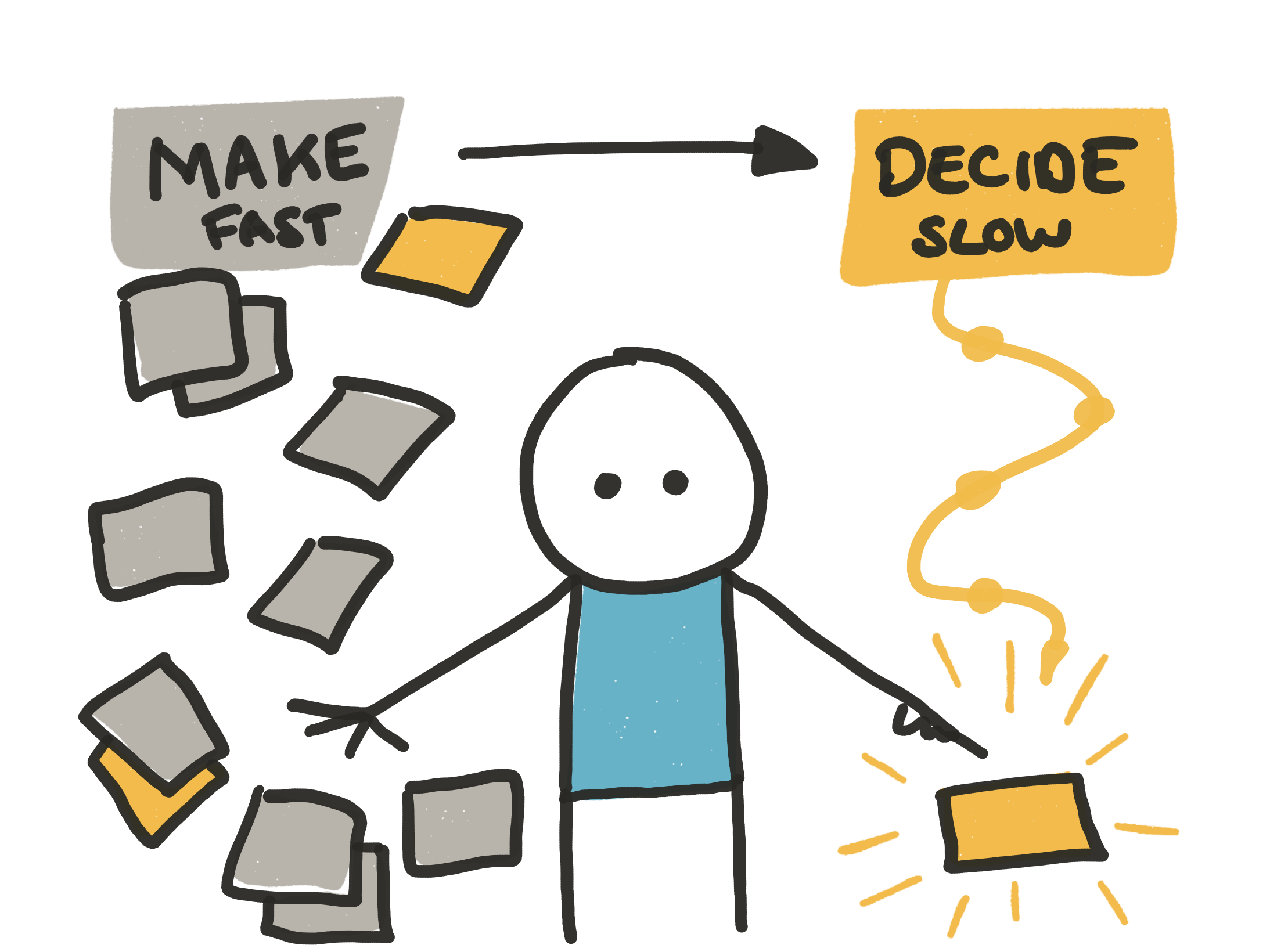
A stick person has a mass of pages floating around on their left - and a single yellow page on their right. The left hand side is labeled ‘Make fast’ - the right hand side is labeled ‘Decide slow’
Design in an age of abundance
Something has shifted.
Not gradually. Not politely. All at once.
We’ve moved into a moment where making things is no longer the hard part. You can generate hundreds of ideas, screens, journeys, or concepts in minutes. You can explore directions that used to take days before your first coffee.
And yet… a lot of it feels a bit blah. A bit same-y.
There’s more output than ever. But less that feels distinctive.
Less that feels like it came from a person, rather than a system.
Decision-making is harder than ever
When production becomes easy, decision-making gets harder.
The designer’s role shifts. Less time crafting every artefact from scratch. More time selecting, shaping, rejecting. Holding a point of view.
Curation becomes the craft. And taste starts to matter more than speed.
Generate fast, then slow down
There might be a new rhythm emerging.
Generate quickly. Then slow down.
Use GenAI to open up the space. Push outwards. Explore more directions than you normally would. Let it be boring. Messy. Excessive.
Then switch modes.
Edit with care. Remove what feels obvious. Strip back what feels generic. Keep only what has energy.
Because the first wave of output often pulls toward the middle. Toward what’s already been seen. Toward what feels safe for the LLM to suggest.
The interesting work usually involves some further prompts based on what you spot amongst the noise.
Finding the kernels
Every now and then, something small stands out.
A phrase. A structure. A way of framing a problem. A moment in a journey that feels more human than the rest.
Those are the things to pay attention to.
Not the fully formed ideas. The fragments that feel alive.
Grab them. Expand them. Let them shape the direction. Add them to your prompts
Notice what resonates, be ruthless about what doesn’t
It’s tempting to include everything. It all looks compelling and interesting. Part of you hates throwing things away. It might be important later!
But no-one will thank you for the blah blah blah. Or the flat bits. They’ll remember and lean forward when it resonates.
Good work often comes from a clearer stance. Not design by committee. Not purely driven by what the data says will perform best. But guided by a sense of what feels right.
You don’t always need to explain it upfront. But you do need to trust it.
Pushing past the obvious
AI is very good at getting you to a decent first draft. It’s much less good at taking you somewhere unexpected. If you stop at the prompt, you often land in familiar territory. Patterns that already exist. Ideas that already circulate.
So the work isn’t in the generation - it’s in pushing further. Asking better questions. Introducing constraints. Break the structure GenAI gives you. Defy its defaults. Add in the points that were only marginal in the training data.
That’s where a point of view starts to emerge.
What this means for research
This is the part I keep coming back to.
If design becomes more about choosing, then research becomes more about expanding what’s possible to choose from.
AI can help here. Not as a replacement for research, but as a way to stretch it. You can simulate different perspectives early on. Not just “the average user”, but edge cases. Future scenarios. People with very different contexts and motivations.
You can ask:
whose voice is missing here?
what happens at the margins of this experience?
how might this look in five years, not just now?
It also opens up new ways of seeing patterns. Large volumes of qualitative data become easier to explore. Themes surface faster. Connections appear that might have taken longer to spot.
But there’s a trade-off. If the inputs lack depth, the outputs will too.
So the researcher's role doesn’t disappear. It sharpens.
Better questions in. Better signals out. Just make sure the algorithms don’t bland out the interesting bits.
A shift in responsibility?
There’s something slightly uncomfortable in all of this.
Now the tools can do more, so the responsibility sits more clearly with us. We can’t blame the process for bland work. Or the time constraints. Or the lack of options.
We have options now. Too many of them.
So the question becomes: what do we choose to keep?
Questions I’m sitting with
I don’t have neat answers. Just a few things I keep circling:
how do we protect space for judgment, when everything pushes toward speed?
what does “good taste” look like in a team, not just an individual?
how do we avoid designing for the average, when the tools naturally drift there?
what new forms of research emerge when we can simulate perspectives at scale?
where should we deliberately slow things down, even when we don’t have to?
It feels like we’re only just starting to understand this shift. But it’s an interesting place to be. Speed doesn’t help us with making better choices. How do we keep that at the centre?
